Agent Node
The Agent Node enables AI-powered automation within your workflows. It connects to AI Models and can use tools (Slack, Gmail, GitHub, etc.) to perform multi-step reasoning and task execution. The agent autonomously decides which tools to use and how to combine their results to accomplish complex tasks.
Configuration
Configuring Agent
| Setting | Description |
|---|---|
| System Prompt | Instructions that define the agent's behavior, persona, and constraints. |
| User Prompt | The task or question for the agent to process. Supports dynamic values using {{ }} syntax. |
| Output Format | Defines the structure of the agent's final response. Use this to specify a JSON schema or format that the agent should follow when returning results. |
AI Model
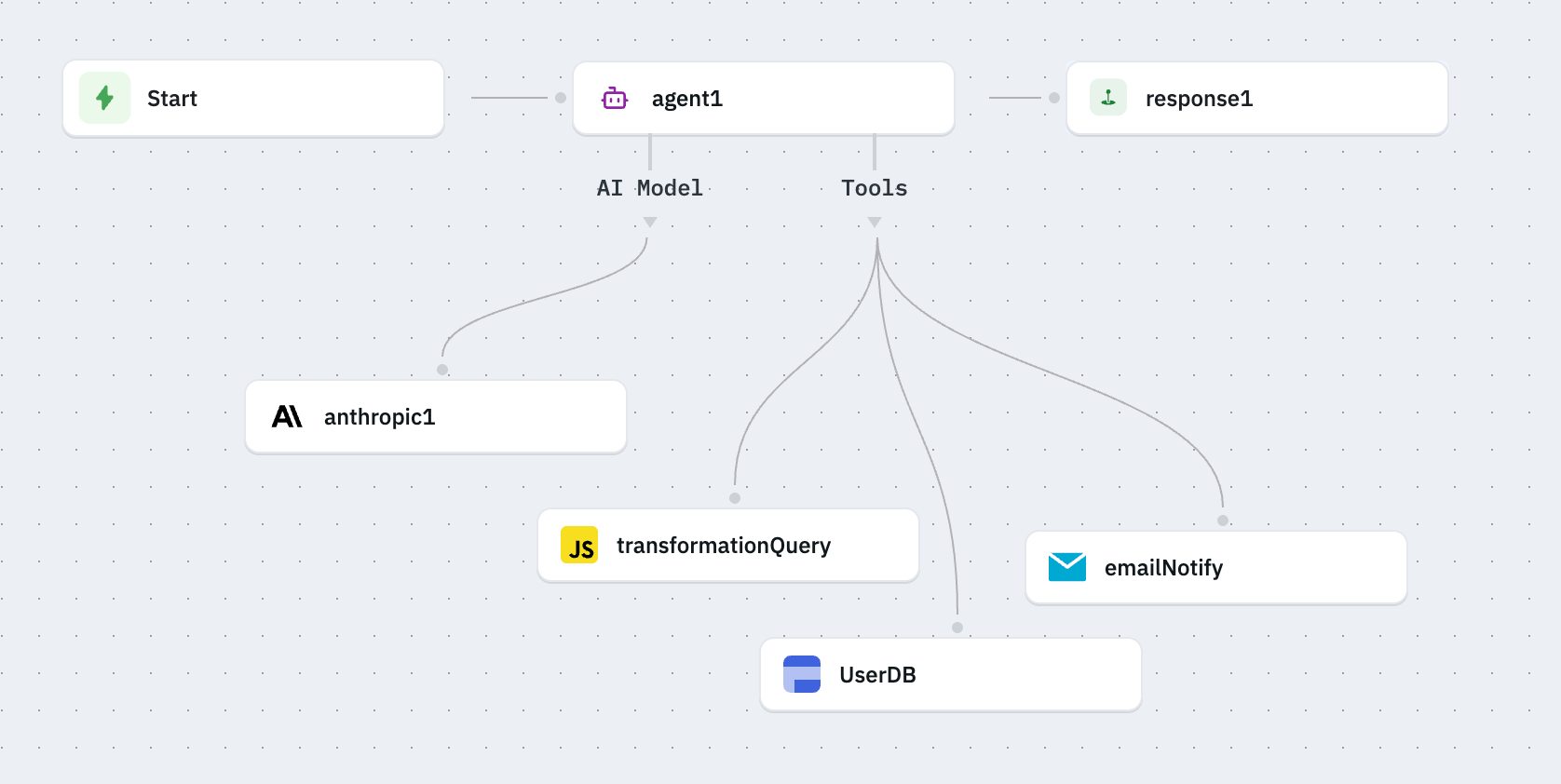
Connect the Agent node to an AI model datasource by linking it to the ai-model handle on the node.
Supported AI providers:
- OpenAI
- Anthropic
- Gemini
- Mistral AI
Model Parameters
| Parameter | Description |
|---|---|
| Temperature | Controls randomness in responses. Higher values (0-1) produce more creative outputs. |
| Max Tokens | Maximum number of tokens the model can generate in a response. |
| Top P | Alternative to temperature for controlling randomness via nucleus sampling (0-1). |
| Max Steps | Maximum number of reasoning steps/iterations the agent can take. |
| Max Retries | Number of retry attempts for failed API calls. |
| Timeout | Maximum time in milliseconds for the agent to complete execution. |
| Stop Sequences | Sequences that signal the model to stop generating further text. |
Tools
Tools allow the agent to interact with your data and perform actions. Each tool is a workflow node that the agent can invoke. The agent autonomously decides which tools to use based on the task and your system prompt instructions.
To add tools, drag nodes from the Agent node's tool handle to connect datasource queries, REST API calls, JavaScript nodes, or any other workflow nodes.
Supported Tool Types
You can use any workflow node as a tool, including:
- Datasource Queries: PostgreSQL, MySQL, MongoDB, and other database queries
- REST API: Connect to external services like Slack, GitHub, Gmail, Twilio, etc.
- JavaScript: Custom logic for data transformation or complex operations
- ToolJet Database: Query your ToolJet Database tables
Accessing Agent Node Data
Inside Tools
When the agent invokes a tool, it passes parameters that you can access within the tool node. Use the following syntax to retrieve these values:
aiParameters.<paramName>
The parameter names are determined by the agent based on your system prompt instructions. For example, if your system prompt instructs the agent to extract user_email from the user's message, you can access it in your tool as:
aiParameters.user_email
Outside Agent Node
Only the final result of the agent node can be accessed by other nodes in the workflow. If you need specific data in the output, define the expected output format in your system prompt.
To access the agent's output in subsequent nodes, use the following syntax:
<agentNodeName>.data
For example, if your agent node is named agent1:
agent1.data
Use Cases
Slack Notification Agent
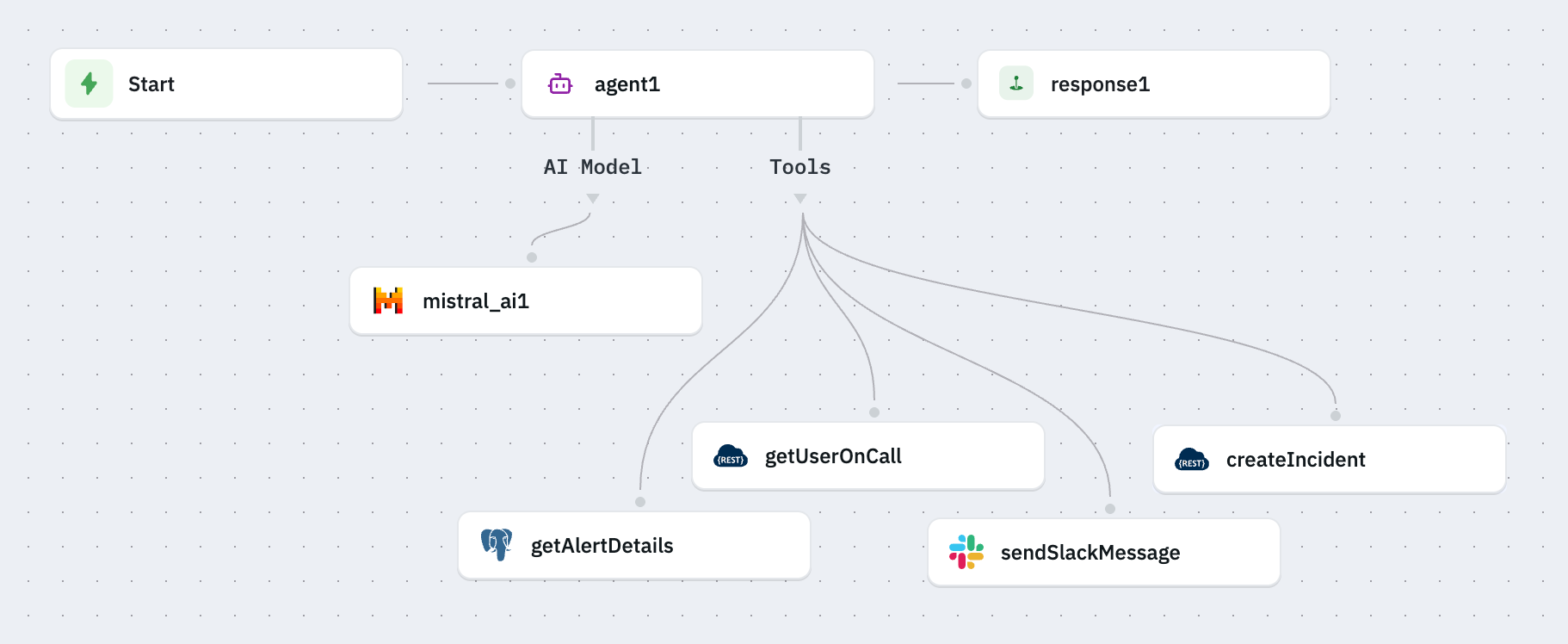
Monitor events and send contextual notifications to the right Slack channels.
Tools:
| Tool | Type | Description |
|---|---|---|
getAlertDetails | PostgreSQL | Fetches alert information from the database |
getUserOnCall | REST API | Gets the current on-call engineer |
sendSlackMessage | Slack | Sends a message to a Slack channel |
createIncident | REST API | Creates an incident in your incident management system |
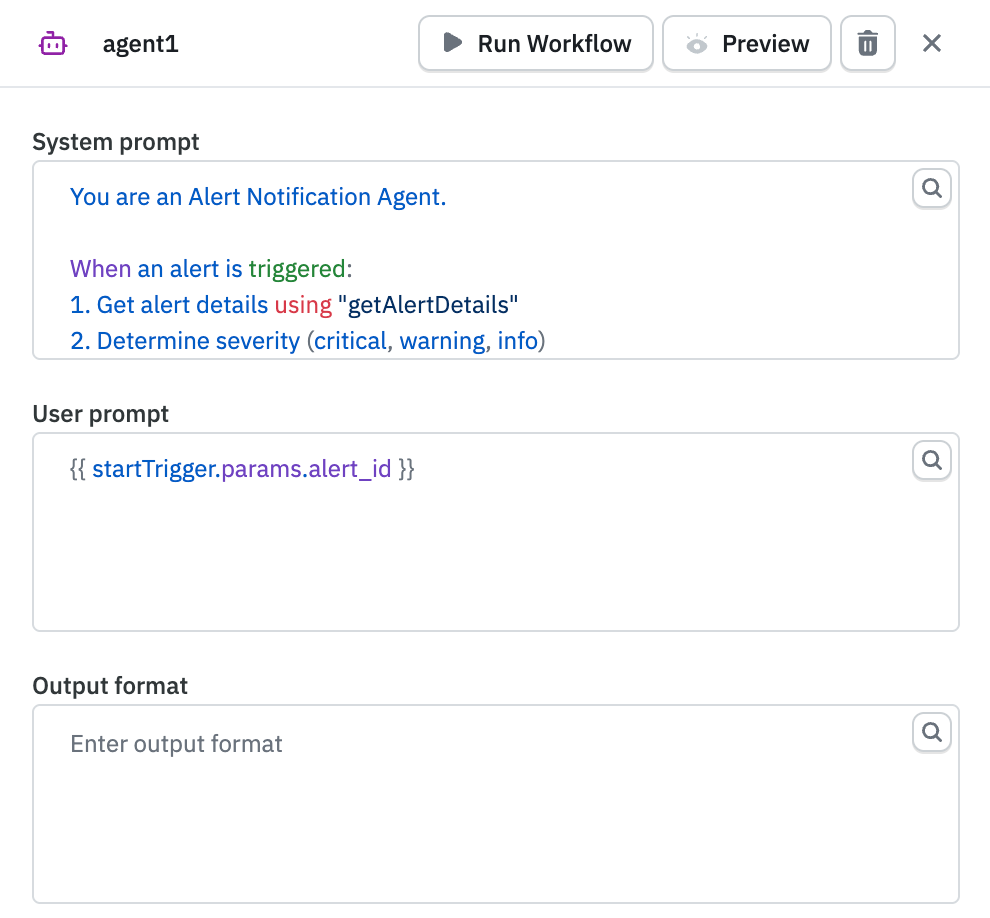
System Prompt:
You are an Alert Notification Agent.

When an alert is triggered:
1. Get alert details using "getAlertDetails"
2. Determine severity (critical, warning, info)
3. For critical alerts:
   - Get on-call engineer using "getUserOnCall"
   - Create incident using "createIncident"
   - Send urgent Slack message using "sendSlackMessage"
4. For warnings: send Slack message to #engineering-alerts
5. For info: send Slack message to #system-logs

Always include: alert name, severity, timestamp, and recommended action.
How It Works:
  Webhook Trigger (alert_id)
        │
        ▼
  Agent Node receives User Prompt
  "New alert triggered. Alert ID: {{ startTrigger.params.alert_id }}"
        │
        ▼
  Agent Reasoning
  AI model reads system + user prompt, plans tool calls
        │
        ▼
  Tool: getAlertDetails (PostgreSQL)
  Fetches severity, service name, timestamp
        │
        ▼
  Severity Check
  ┌─────────────┬─────────────────┬──────────────────┐
  │  Critical   │    Warning      │      Info        │
  │      │      │        │        │        │         │
  │      ▼      │        ▼        │        ▼         │
  │getUserOnCall│ sendSlackMessage│ sendSlackMessage │
  │      │      │ #eng-alerts     │ #system-logs     │
  │      ▼      │                 │                  │
  │createIncident                 │                  │
  │      │      │                 │                  │
  │      ▼      │                 │                  │
  │sendSlackMsg │                 │                  │
  │ #incidents  │                 │                  │
  └─────────────┴─────────────────┴──────────────────┘
        │
        ▼
  Output → agentNodeName.data
  Summary: incident ID, Slack message sent, on-call notified
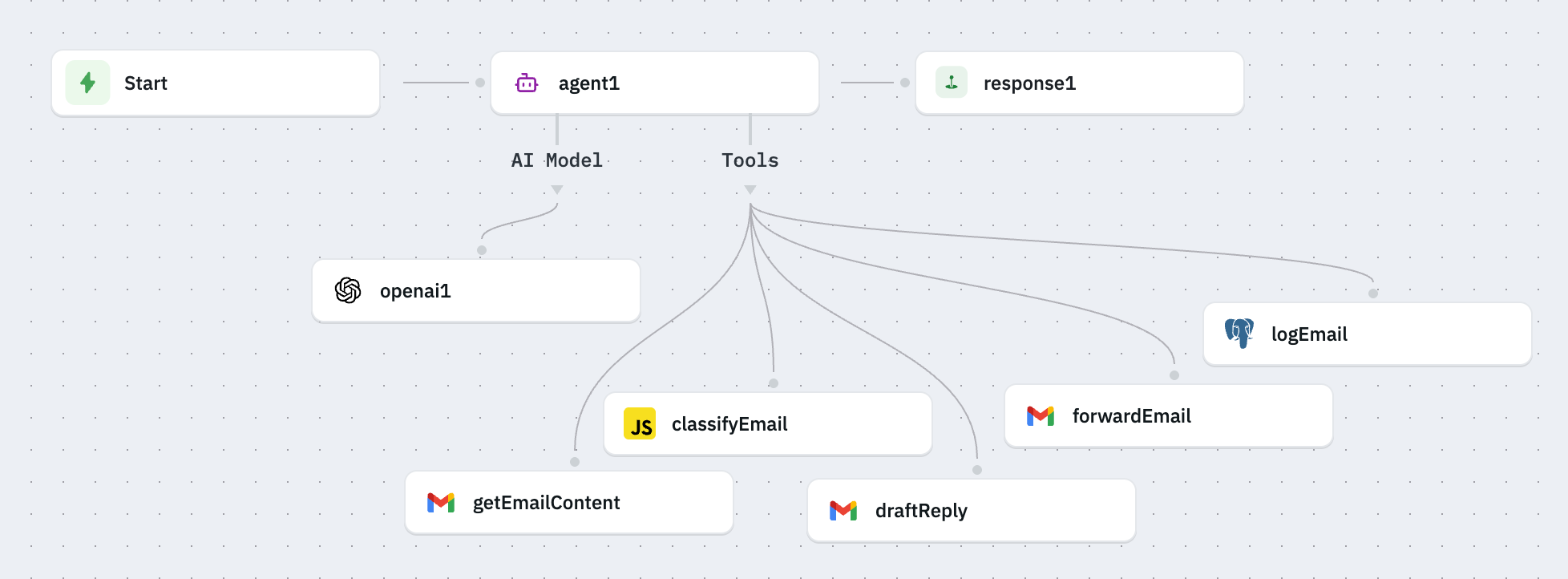
Email Assistant Agent
Process incoming emails and draft responses or route them to the appropriate team.
Tools:
| Tool | Type | Description |
|---|---|---|
getEmailContent | Gmail | Fetches email subject, body, and sender info |
classifyEmail | JavaScript | Analyzes email intent and urgency |
draftReply | Gmail | Creates a draft response |
forwardEmail | Gmail | Forwards to the appropriate department |
logEmail | PostgreSQL | Logs the email for tracking |
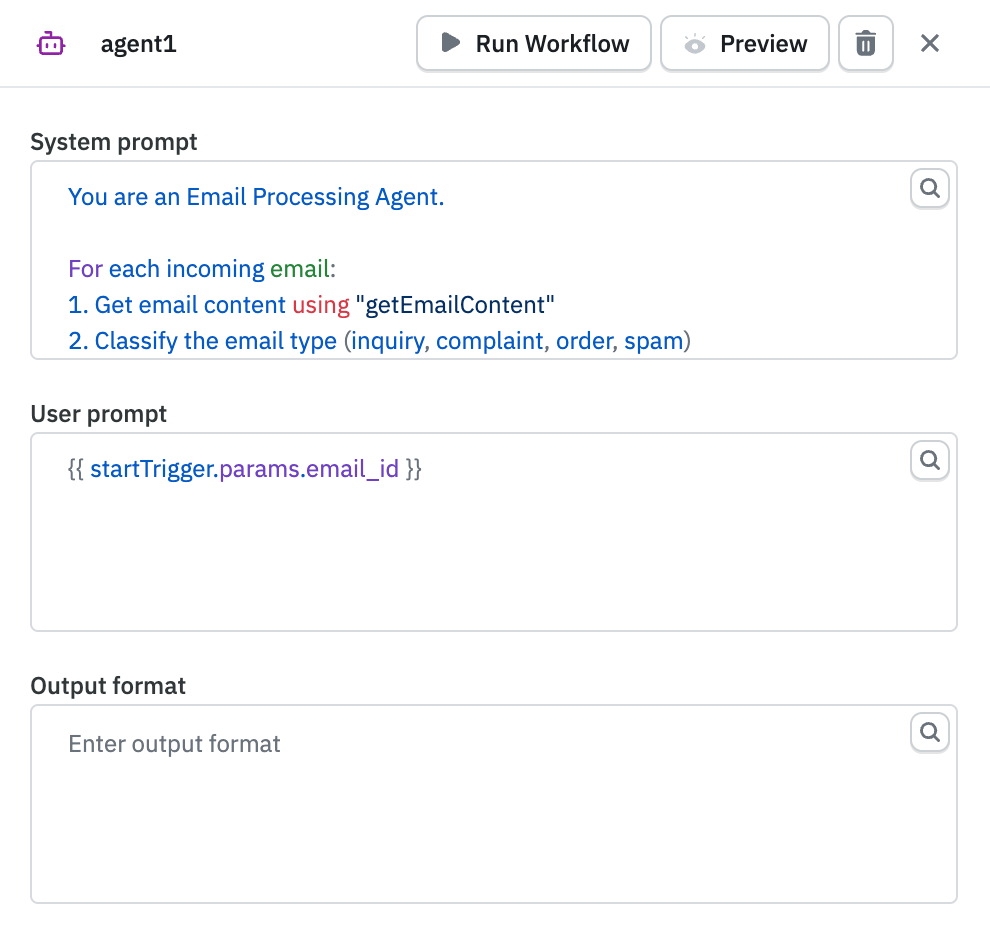
System Prompt:
You are an Email Processing Agent.

For each incoming email:
1. Get email content using "getEmailContent"
2. Classify the email type (inquiry, complaint, order, spam)
3. Based on classification:
   - Inquiries: draft a helpful reply using "draftReply"
   - Complaints: forward to support team using "forwardEmail"
   - Orders: log in database using "logEmail"
   - Spam: ignore
4. Log all processed emails in the database

Maintain a professional and helpful tone in all responses.
How It Works:
  Webhook / Cron Trigger (email_id)
        │
        ▼
  Agent Node receives User Prompt
  "Process incoming email. Email ID: {{ startTrigger.params.email_id }}"
        │
        ▼
  Agent Reasoning
  AI model reads system + user prompt, plans tool calls
        │
        ▼
  Tool: getEmailContent (Gmail)
  Fetches subject, body, sender details
        │
        ▼
  Tool: classifyEmail (JavaScript)
  Returns classification: inquiry / complaint / order / spam
        │
        ▼
  Classification Check
  ┌────────────┬────────────┬────────────┬──────────┐
  │  Inquiry   │ Complaint  │   Order    │   Spam   │
  │     │      │     │      │     │      │          │
  │     ▼      │     ▼      │     ▼      │  Ignore  │
  │ draftReply │forwardEmail│  logEmail  │          │
  │  (Gmail)   │  (Gmail)   │(PostgreSQL)│          │
  └────────────┴────────────┴────────────┴──────────┘
        │
        ▼
  Tool: logEmail (PostgreSQL)
  Logs all processed emails for tracking
        │
        ▼
  Output → agentNodeName.data
  Summary: email classified, action taken, tracking ID
Limitations
- The agent's performance depends on the underlying AI model's capabilities
- Complex multi-tool workflows may require higher max steps settings
- API rate limits from AI providers may affect execution
Need Help?
- Reach out via our Slack Community
- Or email us at [email protected]
- Found a bug? Please report it via GitHub Issues